
By Elaine Walker
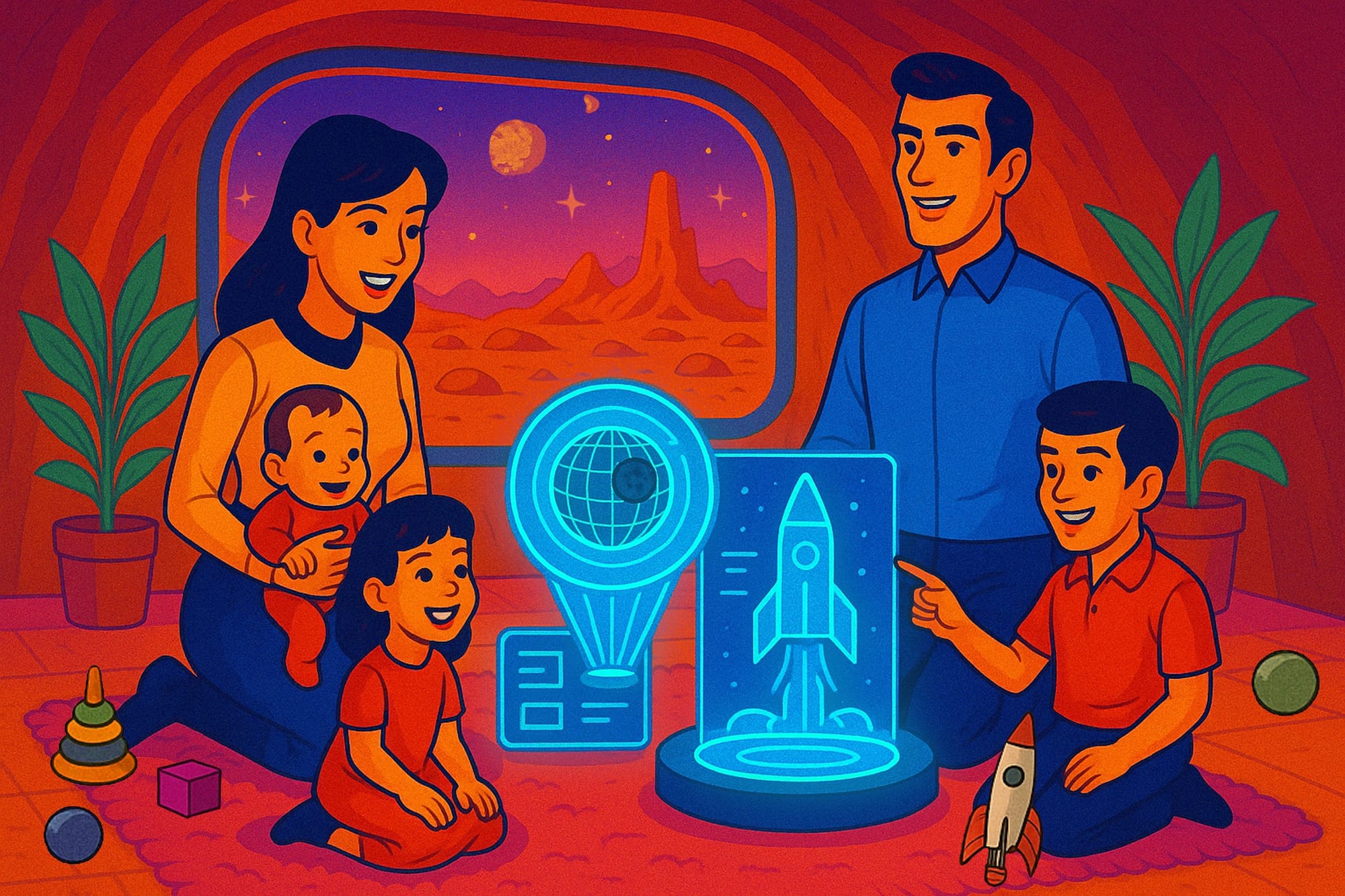
Picture yourself in an early Martian colony. You're sipping hydroponic tea in your inflatable habitat fitted into carved-out rusty cliffs. The red horizon bleeds through your shielded window as you gaze upon your friends tending glowing gardens. Behind you, Earth-born kids chase each other in low-gravity hops, their laughter echoing. That moves your thoughts to your own children-to-be, underground in a radiation-proof vault, the first Martian embryos thawing, ready for a future we're still inventing.
This isn't just a settlement—it's a cradle for humanity's next chapter. But fertility on Mars? It's a beast. Radiation sears cells and gravity plays tricks. Without babies born here, we're just camping, not colonizing. Let's walk through three futures, each shaped by what screws us most: gravity, radiation, or both. Each is a glimpse of how fertility could define Martian life, and why we need to get curious now.
If Gravity Governs
Pregnancy bends under low gravity, and Martian culture reshapes around it.
It's 2068. You wake in Valles Marineris in your regolith-shielded habitat to the sounds of your growing child. Born here, he is wiry—tall, light-boned, hopping like a gazelle in 38% gravity. But pregnancy was hell. Mars' weak pull messes with fetal skeletons and hearts, slowing development.
Your sister spent nine months in an orbiting "pregnancy station," a spinning wheel with small windows mimicking Earth's gravity. It's a Starship-launched centrifuge made from several inflatable segments that auto-assembled in orbit. It's not exactly a 2001 fantasy, but it gets the job done. "See you in nine months, honey," her partner joked as she boarded. It worked—her pregnancy went more smoothly, baby's healthy, but the station's a bottleneck. Only so many moms can spin at once. Also, the Coriolis effect made her sister a bit queasy, but there are plans to add more segments to the wheel soon, and the larger diameter will mean a more pleasant gravity.
Then there's the head-brain puzzle. Your kid's skull is softer and less rigid in low gravity, giving their brain breathing room to spread out. Are we breeding grey alien noggins? Bigger brains may or may not mean smarter Martians, but births are tricky—fragile skulls risk injury, and big heads scream for C-sections. This leads to a topic I'm super uncomfortable with, but I may have to eventually come around.
Artificial wombs—ectogenesis—could be the game-changer. I'd personally rather birth in a cave, but if brains swell, natural delivery's a nightmare. In this future, bioreactors also hum underground, growing babies in gravity-controlled vats. Parents visit, talking and singing to their growing bundles, watching tiny hearts pulse on screens. It's not ditching motherhood—it's survival.
Settlers adapt, blending natural births for the brave with ectogenesis for safety. Martian culture reveres "cave-moms," "spin-moms," and "vat-kids" alike, but the low birth rate keeps you up at night. With its Brave New World specter of engineered humanity, Ectogenesis research may languish until an urgent need to seed off-world populations forces its unsettling rise. But can we at least not call them vats, please?
If Radiation Rules
Cosmic rays force us underground, and fertility science leads the way.
It’s 2086, Noctis Mons. You live in a bustling underground city, walls lined with water tanks to block cosmic rays. Kids play in shielded parks, their targeted taps lighting up holographic murals of Earth's oceans. Radiation's the foe—galactic cosmic rays and solar flares can nick DNA, as the Earth orbit mouse studies had warned. But you're ready. At 20, you banked eggs in a cryo-vault, a Mars tradition as common as a Quinceañera or sweet sixteen party. Young men freeze sperm too, protecting stem cells from radiation's slow burn. Any unused embryo stays frozen for the future. Famously, a NASA scientist named Kelly Burke, nearly 75 years ago, birthed a kid from a 19-year-frozen embryo, foreshadowing what would become a common practice here and now.
Fertility's a community affair. Cryo-vaults are sacred, guarded like treasures. IVF clinics hum, thawing samples for pregnancies in shielded bunkers. To boost the odds, you've got a gene-edited implant, CRISPR'd to enhance DNA repair, inspired by extremophiles. It's standard gear, hardening gametes against rays. Babies are born healthy, raised in vibrant habitats with hydroponic gardens and companion animals.
Surface trips are a treat, in radiation suits, guided by robots or auto-rovers carrying your extra life support. Art celebrates cryopreservation; festivals honor "frost-parents." Life's not locked down—it's thriving, with settlers outsmarting radiation through tech and grit. The birth rate's steady, and you're proud to be part of Mars' growing clan.
If Gravity and Radiation Double Down
When two enemies strike at once, settlers get creative—or risk collapse.
Welcome to Acidalia Planitia, 2091. You split time between a lively underground city and an orbiting pregnancy station, a spinning hub at 1g. Radiation and gravity are equal beasts—cosmic rays demand shields, and Mars' 38% pull warps fetal growth. You banked eggs young, like all settlers, and your kid's growing in an artificial womb on the station, one of many bioreactors humming with life. Natural births happen below, but most opt for ectogenesis, dodging skeletal risks and radiation hits. It's a choice, not a mandate, and settlers proudly champion it.
Hypergravity is another hurdle, but ironically, a solution in a different form. Rocket launches to the station, with their intense g-forces, stress fetuses, and some moms can't fathom leaving family for months—or launching at all. So settlers dusted off a long-forgotten 2016 NASA concept: a wild 300-meter hypergravity train, a ground-based centrifuge spinning up to 2g to mimic Earth's pull. Constructed in a shielded Martian valley, it's a cosmic merry-go-round where moms can gestate in 1g without leaving home. IVF or conception happens right there, keeping families close. It's not perfect—space is tight—but it's a win, blending old NASA dreams with Mars grit.
Your kid's a Martian through and through—tall, lean, and attractively larger head. Those grey alien vibes are real, but C-sections or vats make births smooth. You're augmented: exoskeletal jumper for strength, gene edits for radiation resistance, neural implants tracking health. AI companions help to teach your kid, doubling as health monitors. Habitats bloom with Earth-like biomes—farms, forests, pets—recycling air and waste for self-sufficiency. Martian culture's electric: "cryo-parents," "spin-babies," and "train-moms" are woven into song lyrics. Art weaves tech and humanity. Settlers innovate, using hibernation-like gene tweaks to time births for solar minimum. The birth rate's climbing and you feel it—Martians are crafting a bold new home.
Rewriting Humanity’s Future
Mars will reshape us, no matter the threat. Gravity stretches us tall, thins bones, and swells skulls. Radiation demands shields and gene hacks. Both push us toward cryopreservation, ectogenesis, and augments. Evolution's too slow—we're steering it. Exoskeletons, skin mods, neural AI—Martians will be a new breed, wired for rust. Epigenetic tweaks, like Earth's space-mouse pups, hint at DNA adapting, but biotech's our rocket fuel.
Our biology's malleable. Martians will evolve traits we can't dream, shaped by tech and guts. We're not just colonizing—we're birthing a new humanity.
Closing Thoughts: No Babies, No Future
Gravity and radiation will sculpt our kids, but we're sculptors too. As a mom, I know natural births are beautiful, and I'll always cherish the nine months of being literally connected to my child. But even I will cheer on "vats" and hypergravity trains if they save us. Cryopreservation will be our lifeboat in space, any which way.
I want to live as long as possible so that I can witness humanity progress and spread life through the galaxy, but at the very least, Mars! Protecting our fertility is our ticket to cosmic homes.
To live on Mars is one thing. To be born and raised on Mars will be a whole new frontier. This topic's been ignored too long—let's get curious, get bold, and build humanity's Martian cradle.


