
By Elaine Walker
When it comes to the pressing endeavor to spread our life beyond Earth, most conversations revolve around rockets, robots, communications, oxygen, spacesuits, power, food, and shelter. But a quieter existential question looms: Can we reproduce beyond Earth? Without kids being born off-world, we’re eventually doomed as a species.
This article is both a scientific review and a call to action to keep the conversation about fertility-in-space front and center. Transhumanists, who seek to enhance human capabilities through technology, can see space fertility as a testbed for redefining what it means to be human. Cryonicists, whose interest lies in preserving life for future revival, might see parallels in preserving genetic material for space. Spacers, who dream of permanent off-world settlements, should be absolutely clear eyed when it comes to this topic.
I'll start with an overview of space-fertility studies since it's the bulk of data we have to go on. A longer list of research is here.
The All-Too-Quiet Space Fertility Studies
As of 2025, no mammals have given birth in space.
The Soviet Union tried as far back as 1979, hoping rats might reproduce in orbit — but instead, they mostly just floated around. In 1990, quails were equally flummoxed, showing no interest in zero-g mating. (But one has to assume that when humans have freedom in space they will not be too baffled to mate.)

Also in 1979, Soviet cosmonauts launched quail eggs and witnessed the first space-born quail chicks hatching. The success rates were lower than on Earth, and many space chicks showed developmental anomalies. Ten years later, NASA's "Chix in Space" experiment hatched space-flown quail eggs back on Earth. Only the embryos incubated for 9 days on Earth before launch had a good chance of hatching after spaceflight. The rest ceased developing at various stages during spaceflight.
Finally, in 2016, China launched the first microgravity mammalian embryo development study aboard a recoverable satellite. The cryopreserved embryos were thawed in an automated mini-incubator shortly after orbit, and cultured for four days––the length of time they can survive outside a uterus. Some reached the blastocyst stage, though there was notable DNA damage and epigenetic alterations due to cosmic radiation.
Years later, in 2021, Japan had more luck. They flew two-cell-stage mouse embryos to the ISS, which had more radiation protection, so DNA damage was negligible. Astronauts also thawed and cultured the embryos for four days, but divided them between microgravity and artificial 1G gravity. In the 1G group, about 70% of embryos reached the blastocyst stage, whereas in microgravity only 50% did. NASA's 2023 Rodent Research-20 flew forty female mice to the ISS to study ovarian function, hormone cycling, and reproductive health in space. After returning to Earth, they gave birth to healthy offspring. Microgravity may have caused heritable gene expression changes, which will be a key focus of the ongoing multigenerational studies.
Japan and the U.S.A. also took a stab at studying male mice sperm. Japan's 2017 "Space Pup" experiment sent freeze-dried mouse sperm to the ISS for nine months. Despite heavy radiation exposure, the sperm remained viable, producing healthy and fertile offspring on Earth. There was a higher mortality rate, but the pups who survived to adulthood produced normal offspring. NASA's 2019 Rodent Research-9 studied male mice on the ISS for 35 days. Although their seminal vesicles shrank and mild radiation damage occurred, the sperm still worked, resulting in healthy pups back on Earth. It's a surprising and hopeful sign that the reproductive "hardware" may have redundancy.
Various plans are in the works to test whether mouse embryos sent to the ISS and then returned to Earth can be implanted in female mice and develop into healthy offspring. Evidence is leaning toward space being unsuitable for mammalian pregnancy without significant technological advancements.
The Triple Threat to Fertility in Space
Let's examine the three main threats to fertility and childbearing in space and the three most obvious remedies.
☢️ Radiation: The Cosmic Bully
Radiation is one of the greatest threats to fertility beyond Earth. While Earth's magnetic field provides robust shielding to Earth's orbit, destinations like the Moon and Mars expose us to high-energy galactic cosmic rays and solar particle events. These forms of ionizing radiation can directly damage DNA, disrupt ovarian follicle development, impair sperm production, and compromise early embryonic growth. Even short exposures could tank fertility, complicate pregnancies, or seed genetic instability for generations.
Female ovaries are especially vulnerable. Women are supposedly born with a finite number of primordial egg follicles—some of the most radiation-sensitive cells in the body. Damage to these eggs may quietly rob women of their fertility long before symptoms appear.
While men produce new sperm throughout adulthood, their spermatogonial stem cells (SCCs) are also vulnerable. Damage to these cells can damper sperm production. The mouse studies offered hope in this area: a rare population of dormant SSCs (Setd4+) survived high radiation and regenerated sperm function once conditions stabilized. If similar populations exist in humans, we may already carry a built-in fertility backup system. But for now, it's speculative.
Cryopreservation
Cryopreservation to the rescue? Absolutely. While freeze-dried sperm has shown promise in both mice and men, eggs and embryos are too complex and fragile. Cryopreservation (ultra-cold liquid nitrogen storage, around −320°F) remains the gold standard. Cryopreservation for fertility is already routine on Earth, with success stories including the birth of healthy children from embryos frozen for nearly two decades.
It's common for adults to pursue IVF, and cryopreservation of reproductive tissues is increasingly offered to children before they undergo cancer treatments, allowing them to preserve their potential for future biological parenthood.
In future space settlements, gamete banking early in life may become a cultural rite of passage. Radiation-shielded cryo-vaults, much like libraries or power stations, could form the critical infrastructure for every colony, safeguarding the genetic legacy of settlers against radiation exposure.
🌀 Gravity: The Silent Saboteur
Gravity guides nearly every aspect of human development—from the way fluids flow in the body to the orientation of dividing embryonic cells. Reproductive processes, such as ovum transport through the fallopian tubes, blastocyst orientation, and placental development, all appear to rely on subtle gravity-based cues.
The Moon's gravity (16.6% of Earth's), Mars' (38%), and especially microgravity ("zero-G") may not reliably support human gestation. We don't know since mammals have only ever given birth in Earth's gravity. Could the gestation clock itself shift in low gravity? It's possible—but still speculative. Lower gravity could also slow fetal skeletal development, alter cardiovascular system formation, or change overall birth weight and muscle tone.
Artificial Gravity
Could artificial gravity spin hope? Let's hope. Rotating stations—like 2001's iconic wheel—are a sci-fi fix for gravity. Picture twelve inflatable segments (Bigelow Aerospace, we miss you!), packed into a Starship, spun into a cosmic nursery. It's still an open question whether spin-gravity can fool our biology, but most assume that with a diameter large enough, our cells won't know the difference. Too small a diameter, and the Coriolis effect makes us queasy. In theory, flexible connectors could allow us to scale it up.
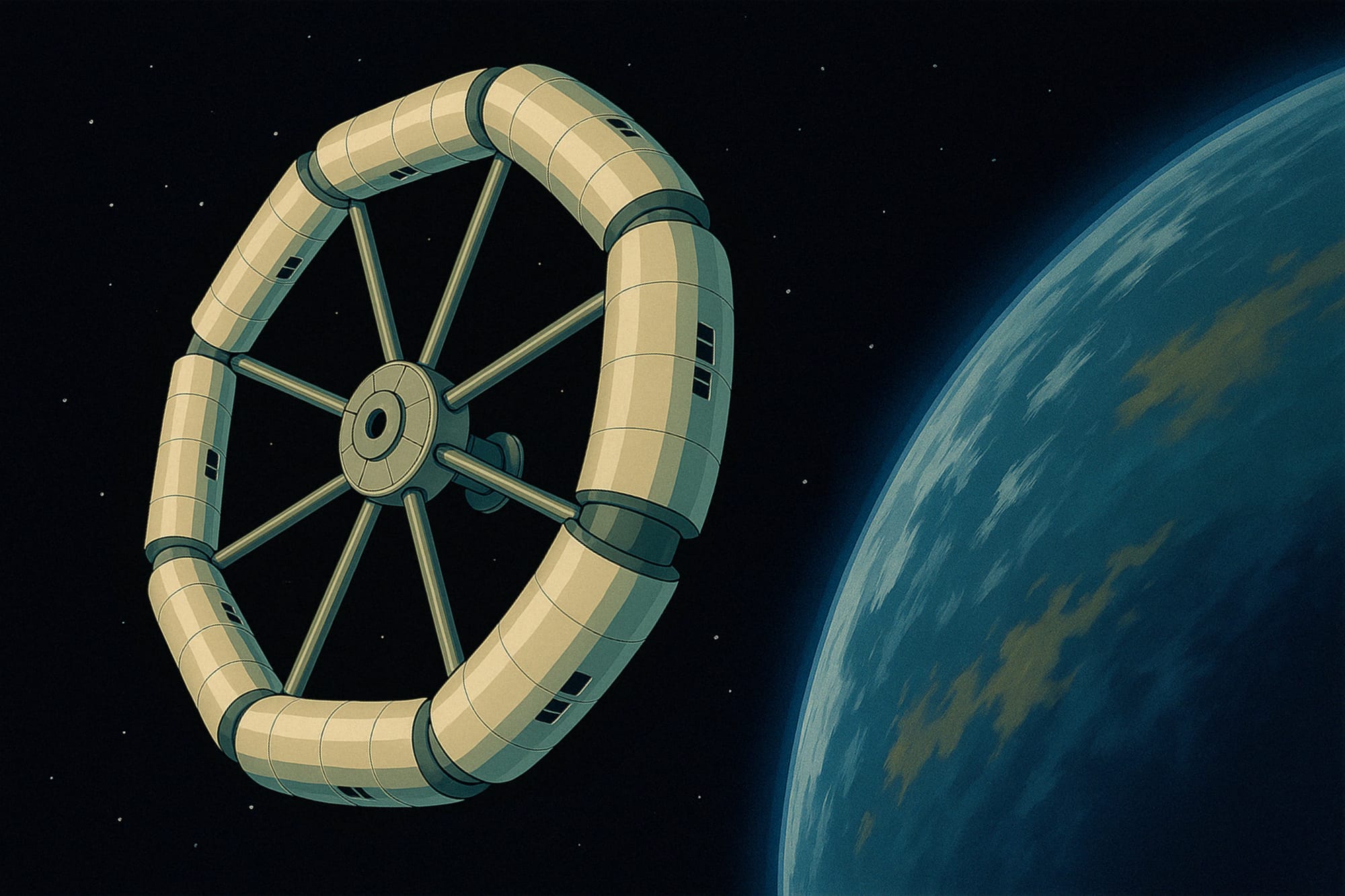
Many have spun up such plans over the decades, but budget competition, fear of vibrations and noisy gears, the complex need to have part of the ship not spin, and disagreements on which gravity (Earth-like? Mars-like?) kill the project every time. We'll likely initially end up with a small centrifuge like 2001's Discovery One. Still cool.
There are also standard ground-based hypergravity centrifuges, such as what astronauts train in. And there may even be a less disorienting terrestrial option. A 2016 NASA paper proposed an Extended-Stay HyperGravity Facility (ESHGF), a 300-meter-diameter ground-based centrifuge using a modular, tilting train-like vehicle to generate adjustable hypergravity (1–2g) for humans, animals, and plants designed for space settlements in need of artificial gravity.
It is apparent in the mouse and quail studies that a bit of gravity, standard or artificial, goes a long way in the early stages. Until we learn otherwise, let's assume the same goes for humans.
🕒 Circadian polyrhythms
The body's internal clock regulates hormones, melatonin, and cortisol, and their misalignment can jeopardize reproductive success. On Earth, irregular light cycles in humans lead to lower fertility, disrupted ovulation, and higher miscarriage rates. Animal studies show that constant light or dark cycles can halt ovulation, reduce embryo viability, and cause abnormal development.
Astronauts in Earth orbit see sunrises every 1.5 hours, potentially scrambling hormonal clocks critical for ovulation and pregnancy. One Moon day is nuts—about 708 hours. That's 29.5 Earth days, with 14 days of constant sunlight followed by 14 days of darkness. Sit back and take a few moments to ponder what's almost too good to be true: Mars' 24-hour-40-minute day (called a sol) is nearly Earth-like. That is the most unspoken, amazing Mars fact.
Artificial Light
Is artificial light good enough? Probably. On the Moon, it's a matter of alternating strategies between the 14-hour daylight and 14 hours of darkness. But that's more manageable than an off-beat rhythm. That said, people in the High Arctic endure shifting day-night cycles all year, with summer being 24-hour light, and winter 24-hour darkness, and they still manage to reproduce. They should be astronauts!
Transhumanist Solutions and Future Directions
I've stated the obvious solutions, but we'll need a patchwork of technologies to truly thrive. Superlongevity research is going in parallel, attempting to take biology to its limits, and lots of overlap will be found such as stem cell therapies and genetics. We must also think beyond biology, embracing transhumanist principles of enhancing human capabilities through technology.
Stem Cell Banking
I've already mentioned cryopreservation of sperm, eggs, and embryos. Stem cell preservation is also becoming a standard for helping cancer survivors preserve fertility. SSCs can be frozen, expanded in lab cultures, and transplanted years later to regenerate spermatogenesis, even after long periods of infertility. In the future, astronauts could bank SSCs before missions, or settlements might develop the capacity to engineer new sperm from stored or stem-cell-derived sources. It's a futuristic insurance policy against deep-space infertility.
I have personal stakes in this conversation. At age 56, I underwent ovarian stem cell therapy—an experimental attempt to reverse menopause and coax new egg production—hoping to freeze viable eggs for my unknown future. I am firsthand observing whether new possibilities for rejuvenating fertility might emerge and what that could mean for humanity's eventual need to reproduce beyond Earth. If techniques like this succeed, they could reshape how we plan for multigenerational survival far from home.
Genetics
Genetic safeguards are another frontier. Research into CRISPR-based gene editing has already shown potential for correcting inherited disorders and enhancing DNA repair pathways. Studies on model organisms and cultured human cells have demonstrated that we can upregulate specific genes involved in DNA repair to resist radiation-induced damage. Though human germline editing (reproductive cells) remains ethically restricted, the techniques for somatic cell repair—and theoretical groundwork for hardening germ cells—are advancing rapidly. Future settlers might receive gene therapies before conception or edit their embryos to bolster resilience against space's harsher conditions.
Artificial wombs
The second best thing next to raising my child was having her snuggled in my belly for nine months. So, I'm always hesitant about the idea of artificial wombs. The technology is advancing, although still in animal models. In 2017, researchers successfully supported premature lamb fetuses in a fluid-filled "biobag," allowing them to develop normally outside the maternal womb for several weeks. While true ectogenesis—growing an embryo entirely outside a biological womb—remains a distant goal, incremental successes suggest that we might eventually transfer some aspects of pregnancy to artificial systems. Artificial wombs could provide a controlled environment for embryonic development, free from space's harsh conditions—a bold step toward redefining reproduction.
In vitro fertilization
In vitro fertilization (IVF) is an excellent example of something that was once considered an extraordinary and controversial intervention—"Test tube babies!"—yet now is quite common. It will likely be a cornerstone of space-based reproductive strategies. IVF clinics aboard future space stations or planetary outposts could enable conception and early embryo screening in shielded environments, minimizing the risks of radiation-induced genetic errors. It might become so necessary in early off-Earth communities that they experience a temporary shift in human culture: reproduction as an active, assisted process, not just a private act.
Conclusion and Call to Action
These technologies, taken together, point toward a future where fertility preservation, assisted reproduction, and genetic optimization aren't just enhancements but a multifaceted survival strategy. For a time, humanity's ability to reproduce off-Earth will depend less on romance and more on a careful orchestration of technologies. But someday, these technologies will become discreetly woven into our culture, so commonplace and expected that romance can then regain its rightful place.
Fertility won't magically "work itself out" on Mars, the Moon, or inside gleaming O'Neill colonies. It will require active protection, careful planning, and relentless technological innovation. And it isn't just a handful of issues to solve. Hundreds of tiny, interconnected biological, mechanical, and environmental puzzles are tied to the single most complex system evolution has ever produced: human life. As we venture beyond Earth, we confront the reality that our biology is tied to this planet. Yet, through innovation, we can transcend these limits. Curiosity is our pilot light, and scientific discovery is the engine—and this engine must now tackle the frontier of fertility.


